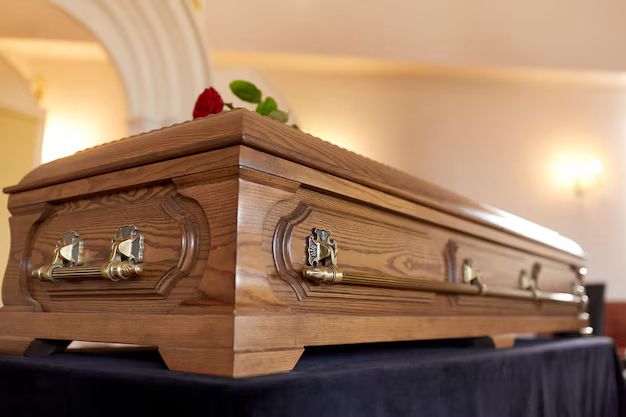
During the recent funeral arrangements for my late father-in-law, I learnt a new term from James, the funeral director. Prior to this, I was not aware that choosing the casket in Hokkien was euphemistically referred to as “geng tua chu”. In English, the phrase is literally translated as choosing a big mansion.
When I first heard it, I thought I heard James wrongly. I was wondering, “Why would he ask me to choose another residence when my father-in-law just passed away in the nursing home? Besides, why would my father-in-law need a mansion now when it would have hardly made to a difference to him even when he was alive but bedbound?”
When I realised what James meant after he repeated himself, I must admit the phrase “geng tua chu” offered scant comfort. After all, the maximum coffin dimensions permitted by the National Environment Agency (NEA) is 2.1m x 0.6m x 0.5m. Just imagine how miserable it would be if my father-in-law’s abode is really of this size!
I suppose when it comes to speaking about death, it is not surprising many may feel uncomfortable talking about it directly and try to romanticise it. After all, death is hardly something people welcome. Moreover, death can sometimes come as a rude shock.
Thus, people especially non-Christians are often inclined to resort to euphemisms to soften the blow of this inevitable reality that we all must face. While some may couch death as being released from pain and suffering, others will speak of death as moving on a “better place” or being reunited with other loved ones who have died.
Interestingly enough, when Paul describes departed saints as “those who have fallen asleep” (1 Thessalonians 4:14), it would appear he was not doing so in an attempt to offer comfort by downplaying the grim reality of death. Instead, the imagery of sleeping conveys a spiritual truth that for Christians, death is but a temporal state since God’s people can have hope in resurrection awakening when Christ returns (v.16-18).
From the Bible, it is clear that death is never portrayed as a friend as much as believers are not to fear it. If anything, death is called “the last enemy” (1 Corinthians 15:26). Apart from faith in Christ, death is the final and ultimate loss.
Death cruelly separates the deceased from their family and friends and denies them from experiencing life as they would have desired it to be. As much as death may seem to be part of the cycle of life in nature, we instinctively still feel death is unnatural and wrong. Rather than to dismiss such sentiments as one being too emotionally attached to the deceased or one’s own life, we should understand that death is not God intention’s for his world.
In fact, even before one experiences death as the ultimate loss, there are usually already “smaller losses” which bring the shadow of death into one’s life. As in the case of my late father-in-law, after a series of falls and operations, he suffered the loss of health, becoming frail and bedbound. But even before the loss of his independence, mobility and gradual loss of appetite, he would already have experienced the loss of youthfulness as his energy level drops. On the workfront, he would also have faced the loss of his “usefulness” since he was not allowed to drive his taxi after turning 75.
If you think about it, whenever people ask about why someone died, we usually talk about the immediate reason. It could be old age, sickness, accident or suicide. But upon further reflection, one should also be mindful that the “wages of sin is death” (Romans 6:23). From Genesis 3, we know that death entered the world because Adam and Eve gave in to Satan’s temptation and chose to sin against God. And ever since then, all of creation remains under a curse of God’s judgment.
But thanks be to God, no matter how many times death may take away our family members and friends, no matter how often we need to look at a lifeless body lying inside a “tua chu”, God’s people can take heart that Jesus has risen and defeated the last enemy. One day, death itself will be swallowed up by the grave (1 Corinthians 15). For while in Adam, all die. In Christ, all shall be made alive (1 Corinthians 15:22).
Here on earth, while my family has to pay for that miserly “tua chu” as well as other funeral expenses including the niche in a Christian columbarium, we thank God that the home that ultimately matters for my father-in-law comes as a gift because of Jesus. Indeed, God has been so gracious to my father-in-law such that he would soften his heart and turn to Jesus in repentance and humble dependence.
That eternal home which my father-in-law receives from Jesus is truly a “tua chu”. For Jesus assures us that “In my Father’s house are many rooms. If it were not so, would I have told you that I go to prepare a place for you? And if I go and prepare a place for you, I will come again and will take you to myself, that where I am you may be also” (John 14:2-3). Knowing that Christ is the one who is graciously preparing our eternal home for us, may we eagerly seek to abide in and honour him all our days until he comes or calls us home.