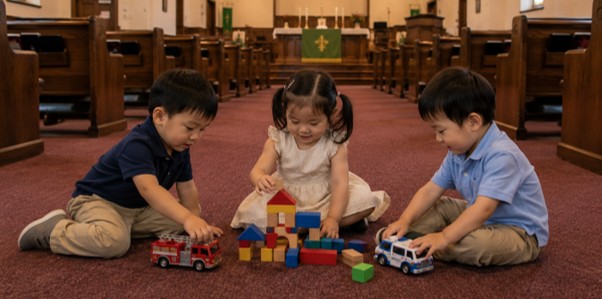
I am often intrigued on Sundays whenever I sit on the last pew seeing young toddlers engaging in parallel play during worship service. And I am most glad that in True Way, we welcome little children in our intergenerational services, even if they may become a little overexcited at times and may require gentle, even firm, reminders to be considerate of others. But that is the nature of young children, to be playful and naturally joyful as they engage in it.
As a pastor in Singapore, I have often noticed how uncomfortable many Christians are with the idea of play. We are generally a hardworking people. From our school days, we are taught to maximise every opportunity, pursue excellence, and avoid wasting time. Even our leisure can become another project to optimise. We track our fitness goals, learn new skills, invest in side hustles, and monetise our hobbies. In a society shaped by meritocracy and efficiency, play can seem unnecessary, even irresponsible.
Yet when we turn to Scripture, we discover that God created human beings not merely for work, but also for delight.
The Bible begins (and ends) not with human labour but with divine creativity (and re-creativity). In the beginning, God created the heavens and the earth, declaring the totality of His creation as not just “good” but “very good.” While God’s work has purpose, it also displays beauty, abundance, and joy. The extravagant variety of plants, birds, land and sea creatures suggests a Creator who delights in what He has made. Even the leviathan, a fearsome creature to mankind, is made by God to frolic or play (Ps 104:16). Creation is not merely functional; it is also playful.
This matters because we are created in God’s image. Human beings are not machines designed only for productivity. We are relational, imaginative, and joyful creatures. We laugh, sing, dance, play games, tell stories, and create art. These activities are not distractions from being human. They are part of what it means to bear the image of God.
The theology of play is rooted in the doctrine of creation. Play reminds us that our value does not come solely from what we produce and own. In a culture that constantly asks, “What have you achieved?,” play quietly proclaims, “I am more than my achievements and possessions.” It is a small act of resistance against the belief that our worth depends on performance.
The Sabbath deepens this truth. God’s command to rest is not merely a prohibitive command to stop working. It is an invitation to trust. By resting, we acknowledge that God sustains the world even when we are not productive. Sabbath reminds us that we are creatures, not creators. We are finite, dependent, and beloved.
Play can therefore become a form of Sabbath practice. When a father kicks a football with his children at East Coast Park, when friends gather for a board game after church, when young adults enjoy a hike at MacRitchie, or when families share laughter over a meal, they are participating in something profoundly human. Such moments remind us that life is received as a gift before it is pursued as a task.
This perspective is especially important in Singapore. Many Christians live under immense pressure. Students worry about examinations, university, and internship placements. Young professionals navigate demanding careers and rising costs of living. Parents juggle work responsibilities and family commitments. Even church ministry can become another source of busyness. We often feel guilty when we are not doing something useful.
Yet Jesus Himself made room for celebration. He attended weddings, shared meals, welcomed children, and spent time with friends. His first recorded miracle occurred at a wedding feast, not in a synagogue or a courtroom. The Gospels present a Saviour who was fully committed to His mission, yet never hurried by the expectations of others. Jesus demonstrates that faithfulness is not measured by constant activity.
Of course, Christian play differs from escapism. Play becomes unhealthy when it is excessive and serves as an avoidance of responsibility or a substitute for meaningful relationships with God and others. The question is not whether we play, but whether our play helps us receive God’s gifts with gratitude and enjoy His presence in creation.
Healthy play restores us for service. It strengthens relationships. It nurtures creativity. It reminds us that joy is not hard-earned but received. Healthy play can also be part of our ministry to others, for through play, we may build others up and point them to the coming kingdom of God.
The Christian hope is not endless work but eternal fellowship with God. Scripture concludes not with exhausted labourers but with a redeemed people gathered in celebration. The biblical vision of the future is often described as a feast, a banquet, and a joyful gathering. In other words, God’s final purpose for humanity includes delight, communion, and joy.
Perhaps this is why play matters more than we realise. When Christians play well, we enjoy and offer others a small foretaste of God’s kingdom. We declare that creation is good, that God’s grace is sufficient, and that our identity rests not in our accomplishments but in His love.
For Singaporean Christians, embracing a theology of play may require repentance from our addiction to busyness and productivity. It may mean learning once again how to enjoy God’s gifts without turning them into projects. It may mean making time for family, friendship, recreation, and wonder.
In doing so, we are not neglecting our Christian calling. We are living more fully into it. For the God who calls us to work is also the God who invites us to play joyfully. And sometimes, one of the most faithful things we can do is simply to receive His gifts with gratitude, laughter, and joy.