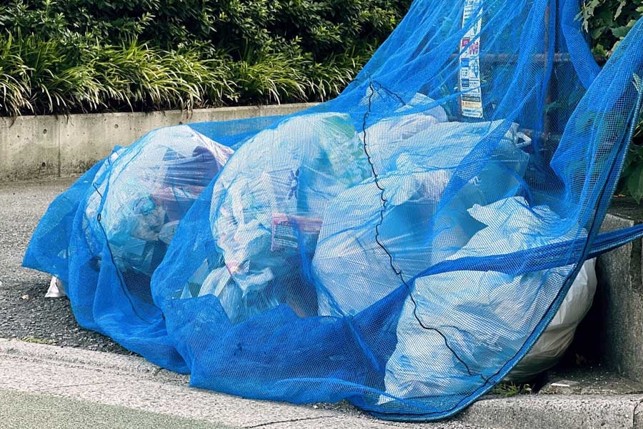
In Japan, at the start of every week I go through a bizarre ritual, and it has to do with trash.
Every Monday morning, I lug one or two yellow bags of garbage and heap them in a pile on the curb at a designated garbage spot in my neighbourhood and cover them with netting so that the crows and cats don’t get to them. The garbage truck comes around only in the morning and so everyone must put their thrash out by 8am. Anything put out after that isn’t collected. And this is just for Monday.
The weekly schedule for garbage pick-up is different for every neighbourhood. In our area, Mondays and Thursdays are for household wastes otherwise known as burnable garbage. Wednesday is for glass, aluminium cans and type 1 plastic bottles (otherwise known as PET bottles in Japan). Friday is for assorted plastics. All the plastic must be washed and dried before it can be put out.
To complicate things further, every 1st and 3rd Wednesday, I can put out recyclable papers. But (BUT) only on the first Wednesday I can also put out metal recyclable items (pots, pans, utensils, etc.) Paper must be tied in neat bundles so that they can be easily picked up; metal must be put in a plain plastic bag with the word ‘metal’ clearly labeled on them. If you just put garbage out carelessly, it can spill, scatter or difficult to collect which can cause a nuisance to the neighbourhood.
Dealing with thrash is just a fact of life and so knowing how to dispose of your garbage is something one know when you move into a neighbourhood. “Where is the garbage point?” is a common question that new neighbours would ask when introducing themselves.
In Japan, dealing with garbage is a personal responsibility. Woe betides whoever misses garbage day as one must keep the smelly trash in the house until the next collection comes around.
This contrasts greatly with Singapore, where you can just conveniently throw your garbage into the chute or a bin whenever you want, leaving the problem for someone else to deal with.
Why have I just spent 400 words talking about rubbish? Because I find dealing with trash to be a fitting metaphor for dealing with sin.
If there is any business that God seems particularly invested in, it could be argued that it is dealing with sin. Arguably the trash of our hearts.
When the Israelites were still a young nation and had just been delivered from Egypt, they had no way of knowing how to live in the presence of a Holy God. This is why God had to give them laws so that they would not perish due to their sins.
For example, the book of Leviticus 16 describes the necessary steps that Aaron, the high priest had to do to make atonement for the sins of the people of Israel. There’s a whole lot of instructions about what he must wear, do and ultimately a lot of killing of bulls and goats. At any time, should Aaron not carry out these instructions to purify himself, he could die.
Leviticus 16:29-31 states,
“And it shall be a statute to you forever that in the seventh month, on the tenth day of the month, you shall afflict yourselves and shall do no work, either the native or the stranger who sojourns among you. For on this day shall atonement be made for you to cleanse you. You shall be clean before the LORD from all your sins. It is a Sabbath of solemn rest to you, and you shall afflict yourselves; it is a statute forever.
Reading this text, the take aways I get is that removing sin was hard work. Purifying oneself was not a simple thing. It took meticulous planning, careful execution and lots of time. Lastly, dealing with sin was costly in terms of lives; countless animals died for the removal of sins. I cannot imagine how smelly and disturbing the scene was with all that blood and the smoke of burnt flesh wafting in the air. But that is exactly what dealing with sin is like. It is hard work, it is costly, it is important.
It is truly an unimaginable grace that the Lord should take it upon Himself to do all the hard work and go through all the suffering required to deal with sin once and for all through His death on the cross.
As a result, today it seems almost too easy to deal with sin. One only has to bow one’s head in prayer, confess their sins and have faith that in Jesus’ name that sins are forgiven. While it is a privilege to be given such access to the throne of Grace, perhaps we have lost something in the process.
In Singapore, I never thought much about my rubbish; I just bag it and throw it down the chute every day. Even chucking out something large like a table could be handled easily because our cleaners could be enlisted to take them away. However, in Japan, because the duty to sort the trash falls on individuals, I’m often conscious about how much trash I am producing. Also, knowing that throwing away an unwanted product is difficult and costly makes me think twice about buying things.
Dealing too lightly with sin prevents us from grasping the true weight of how seriously God views it, especially when we fail to intentionally consider its costs. Using the Old Testament Law to understand God’s serious view of sincan renew our minds and deepen our appreciation for His immense grace, without requiring a return to ancient practices. May the Lord guide us as we reflect on this.